
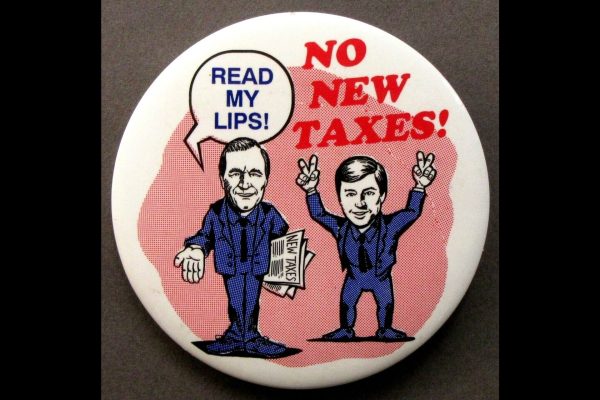
In August of 1988, George H.W. Bush stood in front of the Republican National Convention in New Orleans and emphasized six words which would later be remembered in infamy: “Read my lips: no new taxes.” He hung on every word, hammering home exactly what members of his party wanted to hear. The crowd at the RNC roared. The words were simple, strong, and memorable, and aided him in securing the vote for President later that year.
Two years later, the deficit was rising, and the Democratic-controlled Congress was pushing Bush to sign a budget deal. Under growing pressure, Bush signed the budget, and with his signature, raised taxes. Amidst the numbers and the pressure from Congress, Bush decided to compromise. The American people still heard six words in his voice ringing a promise in their minds which earned their vote. In 1992, those words were repeated in political TV ads, printed in the papers, talked about on radio shows, and anywhere else the Clinton campaign could remind the voters of the “lie” Bush had told them four years prior. The words had been said. The damage could not be taken back. Bush lost his reelection bid for the White House.
Words are small things. They pass over the tongue sometimes without the proper thought behind them. Even though they have no mass, their weight can still be felt beyond measure. James said, “So also the tongue is a small member, yet it boasts of great things. How great a forest is set ablaze by such a small fire! And the tongue is a fire, a world of unrighteousness. The tongue is set among our members, staining the whole body, setting on fire the entire course of life, and set on fire by hell” (3:5-6).
Like James’ analogy of how a spark can ignite a forest fire, a single word or sentence can destroy careers, reputations, relationships, or even the presidency.
Our words relay our intentions, feelings, thoughts, and many other things. Saying the wrong words can create promises in the minds of others, intentional or not. When Bush said, “no new taxes,” especially with the emphasis of a father laying down the law in his house, he was not simply making a statement. He was giving his word to the American people. Jesus taught the importance of keeping our word in Matthew 5:37: “Let what you say be simply ‘Yes’ or ‘No’; anything more than this comes from evil.”
When we speak, our “yes” should mean yes, and our “no” should mean no. Solomon gave the same warning in Ecclesiastes 5:5: “It is better that you should not vow than that you should vow and not pay.”
Giving our word to someone is a debt we now owe to them in the eyes of God. While most of us will not be owing that debt to millions of people living in a nation, even owing it to a single person is still a debt which we should take seriously. Intentions aside, we have all made promises we did not keep. The country singer Randy Travis sang the words, “I hear tell the road to hell is paved with good intentions.” When we speak in anger, pride, or carelessness, or make promises without following through, darkness can taint our own souls. Apologies cannot recall words. Once they are spoken, they no longer belong to us.
Jesus warned in Matthew 12:36-37, “I tell you, on the day of judgment people will give account for every careless word they speak, for by your words you will be justified, and by your words you will be condemned.” Every word, not only the ones spoken in front of a camera, or big ones which make the headlines, but even the small, muttered complaints and the cutting remarks are heard and considered by God, the Almighty who sees and remembers all things.
Why are these words so dangerous, though? It is because they do not begin in the mouth. Jesus said, “The good person out of the good treasure of his heart produces good, and the evil person out of his evil treasure produces evil, for out of the abundance of the heart his mouth speaks” (Luke 6:45).
God desires our heart, and what the tongue speaks reveals what is held in the heart. James reveals the most frightening part: “For every kind of beast and bird, of reptile and sea creature, can be tamed and has been tamed by mankind, but no human being can tame the tongue. It is a restless evil, full of deadly poison” (James 3:7-8).
No matter how good we are, how well we watch our words, we have all sinned, and the temptation to misuse our words is always there, ready to spring forth again. What is our hope? It is Christ, and the free gift of the grace of God offered to us through baptism and repentance. In 1992, the voters had a memory of the things Bush said back in 1988, and he was judged guilty. On the day of judgment, your words will be questioned. Will they ring out to condemn you, or will God blot them out with grace?
Lance Byers