
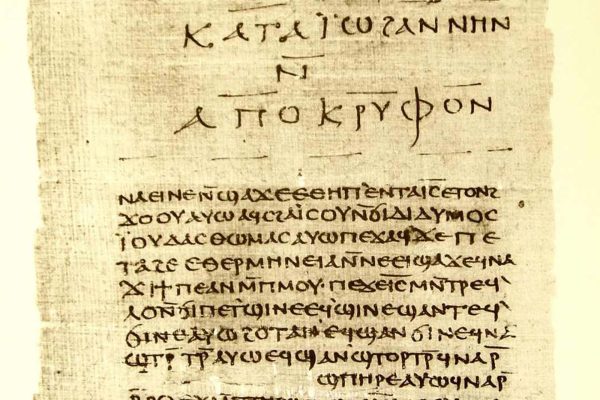
Several years ago, the National Geographic Channel aired, “The Secret Lives Of Jesus,” a show which, according to Tom Jennings, its writer and producer, explores stories found in “alternative gospels” written in the 2nd and 3rd centuries — stories created by Gnostic sects who wanted to share with the world their own version of the stories of Christ. Most of the “stories” were attributed to the “recently discovered” Gospel of Thomas.
Some of the assertions explored in the show include proclaiming that Jesus was a troubled child who once crippled a boy because His victim’s father had told on Him out for making clay pigeons on the Sabbath. To make the evidence disappear, Jesus brought the pigeons to life and made them fly away. Another assertion suggested that Jesus had a special relationship with Mary Magdelene. The story goes that Jesus brokered Mary Magdelene’s prostitution, and this is supposedly proven when Jesus scolded the crowd with the statement, “He that is without sin among you, let him first cast a stone at her” (John 8:7). The final example is that when Simon took the cross from Jesus, Jesus removed His crown of thorns and placed it on Simon’s head.
Simon, stunned and confused, bent down, shouldered the cross and began the journey out of town toward his own execution. Jesus stepped back into the crowd and laughed as he watched Simon being led away in His place. Jesus then turns and walks in the opposite direction — ready to move on with an apparently happy and long life.
The Gospel of Thomas is a papyrus Coptic manuscript discovered in 1945 at Nag Hammadi, Egypt. Unlike the four gospels in the Bible, which combine narrative accounts of the life of Jesus with sayings, Thomas is a “sayings” gospel. Thomas does not have a narrative framework; it comprises 114 sayings attributed to Jesus. Some of these sayings resemble those found in Matthew, Mark, Luke and John. Others were unknown until its discovery, and a few of these run counter to sayings found in Matthew, Mark, Luke and John. In Matthew, Mark, Luke and John, Jesus is shown to be the Messiah. In the Thomas gospel, Jesus is a spiritual role model, and He is offering every- one the opportunity to become anointed (a Christ) as He is. For example, in Thomas vs. 108, Jesus said, “Whoever drinks from my mouth will become as I am; I myself shall become that person, and the hidden things will be revealed to him.” Furthermore, salvation is personal and found through introspection. In Thomas vs. 70, Jesus says, “If you bring forth what is within you, what you have will save you. If you do not bring it forth, what you do not have within you will kill you.”
Although the Gospel of Thomas is well-known, there are actually several of the spurious “gospels.” Standards for inclusion in New Testament canon include apostolic approval (This does not necessarily mean apostolic authorship), genuineness (Is it the product of those for whom it is claimed?), authenticity (s it a record of actual facts truly stated?) and testimony (hat are the contents of the book itself and what is the testimony of early writers regarding the book?). Bible scholar Bruce Metzger wrote regarding the formation of the New Testament canon, “Although the fringes of the emerging canon remained unsettled for generations, a high degree of unanimity concerning the greater part of the New Testament was attained among the very diverse and scattered congregations of believers not only throughout the Mediterranean world, but also over an area extending from Britain to Mesopotamia.” In short, all the books that belong in the Bible are in the Bible! It is always wise to know the proper responses and defenses to questions your friends may have about television shows like these (1 Peter 3:15). The truth will stand against scrutiny!
Kyle Campbell